
The Ultimate Guide to Off-Grid Solar Battery Storage
Master Your Energy Sovereignty with Engineering-Grade Infrastructure SOPs
Choosing the right Battery Energy Storage System (BESS) is the most critical decision for any high-performance off-grid build. In a landscape filled with “lifestyle” marketing, this guide provides the technical data, Levelized Cost of Storage (LCOS) benchmarks, and installation protocols required to build a resilient, independent utility.
Whether you are auditing your off-grid load profile for a remote cabin or engineering a whole-home backup for a suburban estate, the following sections break down the world’s top 10 battery systems with professional-grade depth.
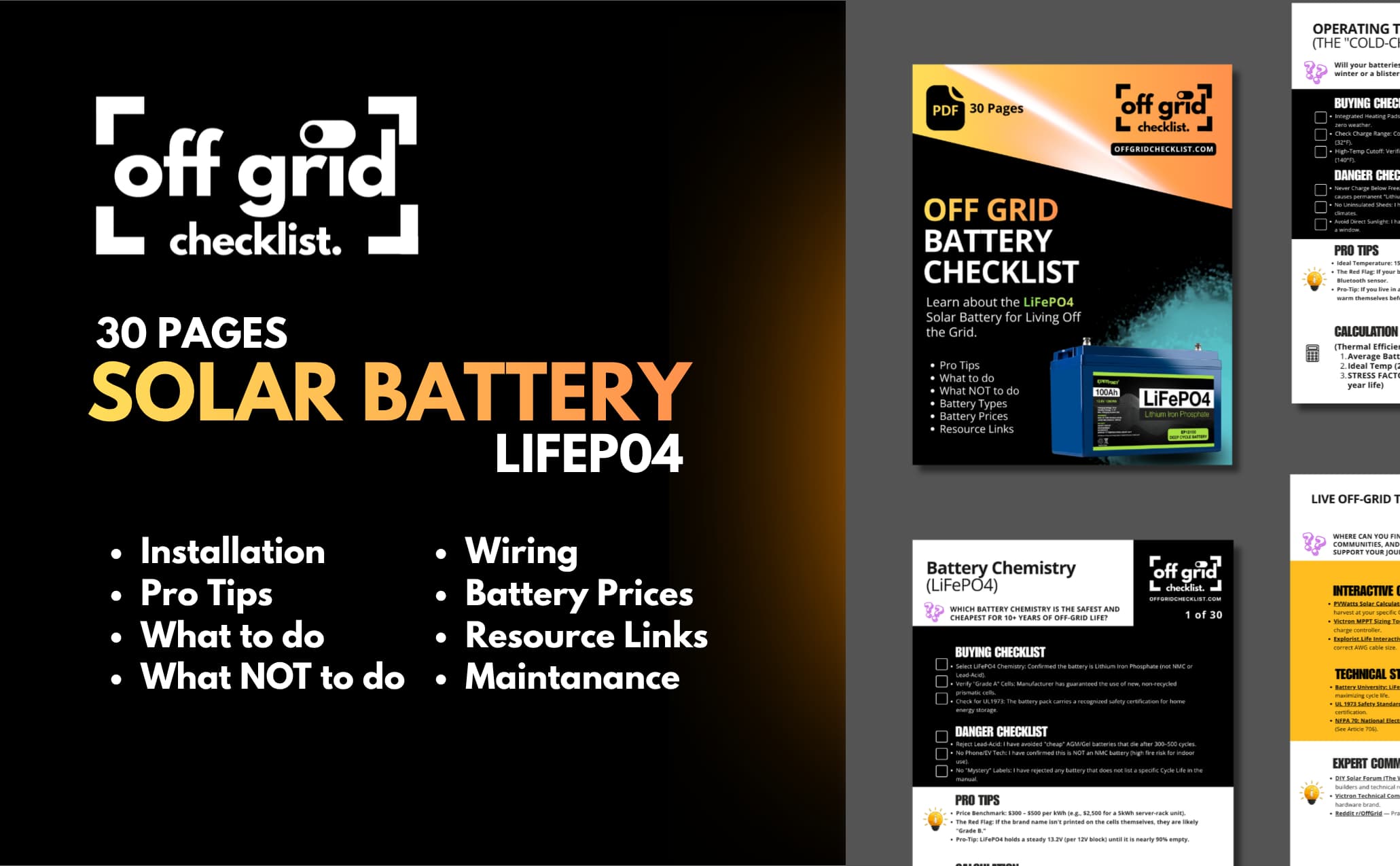
The 48V Off-Grid Solar & Lifep04 Battery SOP PDF
The Blueprint for Professional Energy Independence Moving beyond basic power means moving to the 48V Standard. This 30-page SOP provides the high-density technical engineering required to build a “bank” that doesn’t just work—it survives.
The Global Solar Battery Comparison Matrix
To achieve true energy independence, hardware must be evaluated based on engineering reality rather than marketing. This comparison uses the Levelized Cost of Storage (LCOS)—the primary metric that accounts for a battery’s total lifetime value. By analyzing usable capacity and continuous power output, you can accurately perform an off-grid load profile audit to ensure your system meets your daily demand without failure.
Tesla Powerwall 3
Capacity: 13.5 kWh
Continuous Power: 11.5 kW
Peak Surge: 30.0 kW
Est. Price: £7,750 / $9,000
Enphase IQ 5P
Capacity: 5.0 kWh
Continuous Power: 3.84 kW
Peak Surge: 7.68 kW
Est. Price: £3,500 / $4,000
EG4 PowerPro
Capacity: 14.3 kWh
Continuous Power: 10.2 kW
Peak Surge: 15.0 kW
Est. Price: £2,800 / $3,500
BYD HVM
Capacity: 8.3 – 22.1 kWh
Continuous Power: 10.2 kW
Peak Surge: 15.4 kW
- Est. Price: £5,900 / $7,200
EcoFlow Ocean Pro
Capacity: 10 – 80 kWh
Continuous Power: 24.0 kW
Peak Surge: 30.0 kW
Est. Price: £8,500 / $10,500
Tesla Powerwall 3
(The All-in-One Benchmark)
The Tesla Powerwall 3 is the industry’s leading integrated storage solution, featuring a built-in hybrid inverter that eliminates external hardware. Supporting 20kW of DC solar input directly, it minimizes round-trip efficiency losses by streamlining the energy path.
This model utilizes Lithium Iron Phosphate (LFP) chemistry for superior thermal stability and longevity. Engineered for high-demand environments, its massive inductive load surge capacity allows a single unit to start heavy equipment like well pumps or large air conditioners that typically require multiple stacked batteries.
Country Demand: USA, UK, Australia, Germany, Canada.
Price: ~£7,750 / $9,000 (Unit only; excludes Gateway 3 and installation).
Specs: 13.5 kWh capacity, 11.5 kW continuous output, 185A LRA start capability.
Uses: Off-grid residential primary power and high-surge appliance support.
4 Features: 6 MPPT solar inputs, IP67-rated waterproof electronics, “Storm Watch” AI grid protection, and seamless expansion with plug-and-play DC modules.

Enphase IQ Battery 5P
(The Reliability Leader)
The Enphase IQ Battery 5P sets the standard for system resilience through its unique distributed architecture. Unlike traditional units, it features six embedded grid-forming microinverters, ensuring that a single component failure never compromises your entire Battery Energy Storage System (BESS).
This AC-coupled design allows for rapid installation and seamless integration with existing solar arrays. With a high inductive load surge capacity—delivering twice the continuous power of previous generations—it is specifically engineered to start power-hungry appliances during a grid outage while maintaining a stable, high-performance off-grid load profile.
Country Demand: USA, Australia, UK, France, Mexico.
Price: ~£3,500 / $4,000 per 5kWh module (Excludes System Controller 3).
Specs: 5.0 kWh capacity, 3.84 kW continuous power, 7.68 kW peak surge (3s).
Uses: Highly reliable residential backup and modular off-grid scaling.
4 Features: 15-year limited warranty, fanless passive cooling, “Power Start” motor technology, and hardwired “Control Cable” communication for maximum signal stability.

EG4 WallMount PowerPro
(The DIY Disruptor)
The EG4 WallMount PowerPro is a heavy-duty, outdoor-rated 48V battery designed for maximum energy density at a lower price point. Featuring a massive 14.3 kWh capacity, it serves as a robust alternative for those building large-scale Battery Energy Storage Systems (BESS).
Its standout feature is the integrated self-heating mode, which allows the Lithium Iron Phosphate (LFP) cells to charge safely in sub-zero temperatures—a requirement for unheated off-grid cabins. The unit also includes dual on-board fire arrestors and a built-in 200A BMS, ensuring high-level safety while maintaining a consistent off-grid load profile during heavy discharge.
Country Demand: USA, Canada, Mexico (Expanding into South America).
Price: ~$3,499 / £2,800 (Unit only).
Specs: 14.3 kWh capacity, 10.2 kW continuous output, 15.4 kW peak surge (3s).
Uses: Off-grid workshop power, residential backup, and high-capacity DIY solar stacks.
4 Features: Integrated 600A busbars for easy paralleling, EMP protection, 8,000+ cycle life (80% DoD), and a plug-and-play conduit box for 18kPV inverters.
EG4 WallMount PowerPro
(The DIY Disruptor)
The EG4 WallMount PowerPro is a heavy-duty, outdoor-rated 48V battery designed for maximum energy density at a lower price point. Featuring a massive 14.3 kWh capacity, it serves as a robust alternative for those building large-scale Battery Energy Storage Systems (BESS).
Its standout feature is the integrated self-heating mode, which allows the Lithium Iron Phosphate (LFP) cells to charge safely in sub-zero temperatures—a requirement for unheated off-grid cabins. The unit also includes dual on-board fire arrestors and a built-in 200A BMS, ensuring high-level safety while maintaining a consistent off-grid load profile during heavy discharge.
Country Demand: USA, Canada, Mexico (Expanding into South America).
Price: ~$3,499 / £2,800 (Unit only).
Specs: 14.3 kWh capacity, 10.2 kW continuous output, 15.4 kW peak surge (3s).
Uses: Off-grid workshop power, residential backup, and high-capacity DIY solar stacks.
4 Features: Integrated 600A busbars for easy paralleling, EMP protection, 8,000+ cycle life (80% DoD), and a plug-and-play conduit box for 18kPV inverters.

EcoFlow Delta Pro 3
(The Hybrid Portable)
The EcoFlow Delta Pro 3 represents the next generation of hybrid storage, bridging the gap between portable power and dedicated home backup. Featuring a 4kWh base capacity that is expandable to 12kWh, it is engineered to maintain a consistent off-grid load profile even under heavy use.
Its proprietary X-Stream technology allows for ultra-fast charging, reaching 80% capacity in under an hour, while its IP65-rated battery pack ensures durability in diverse environments. With a 4000W output capable of handling high-torque motors, this unit is a versatile choice for those requiring a mobile yet powerful Battery Energy Storage System (BESS).
Country Demand: USA, UK, UAE, Germany, Japan.
Price: ~$3,099 / £2,600 (Base unit; varies by bundle).
Specs: 4.096 kWh capacity, 4000W continuous output (8000W peak), 10ms UPS.
Uses: Mobile off-grid living, emergency home backup, and high-wattage field work.
4 Features: Dual-PV solar charging (2600W), ultra-quiet 30dB operation, automotive-grade LFP cells (4000 cycles), and smartphone app monitoring via Wi-Fi/Bluetooth.

Bluetti EP900
(The High-Voltage Hybrid)
The Bluetti EP900 is a sophisticated high-voltage modular system designed to function as the primary energy hub for larger off-grid estates. Unlike 12V or 48V systems, the EP900 operates at a higher internal voltage to minimize round-trip efficiency losses during high-power transmission. This architecture allows it to deliver a massive 9kW of continuous AC power, easily maintaining a heavy off-grid load profile that includes electric ovens, clothes dryers, and workshop tools.
When paired with B500 expansion battery modules, the system scales up to 79kWh, providing a professional-grade Battery Energy Storage System (BESS) capable of multi-day autonomy in any climate.
Country Demand: USA, Germany, Netherlands, Italy, Canada.
Price: ~$10,000 / £8,000 (9.9kWh Starter Kit).
Specs: 9.0 kW continuous output, 120V/240V split-phase support, LiFePO4 chemistry.
Uses: Whole-home off-grid power, heavy appliance support, and split-phase workshop machinery.
4 Features: IP65-rated weatherproofing for outdoor installation, 10-year comprehensive warranty, 0.01s UPS switch-over, and bi-directional grid-tie capability (sell back power where legal).

Sigenergy SigenStor
(The AI-Integrated 5-in-1)
The Sigenergy SigenStor is a revolutionary 5-in-one energy system that integrates a hybrid inverter, DC EV charger, and battery PCS into a single stackable tower. Unlike traditional storage, it utilizes a cloud-native AI engine to perform a real-time off-grid load profile audit, predicting weather shifts and adjusting discharge logic to maximize autonomy. This system is the first to offer a 0ms UPS-grade backup, ensuring that sensitive electronics and medical equipment never experience a flicker during a power transition. With its high-density 314Ah cells and 100% Depth of Discharge (DoD), it provides one of the most space-efficient and technologically advanced Battery Energy Storage Systems (BESS) available for modern sovereign builds.
Country Demand: Australia, UK, Germany, Thailand.
Price: From £6,000 / $8,500 (6kWh starter stack with inverter).
Specs: 5kWh to 48kWh per stack, up to 25kW DC EV charging, IP66 rated.
Uses: High-tech home automation, 0ms medical backup, and rapid DC electric vehicle charging.
4 Features: Built-in internal fire extinguisher per module, “Aerogel” thermal insulation, 10,000 cycle life, and V2X (Vehicle-to-Everything) bi-directional readiness.
Pytes V16
(The Outdoor Heavy-Duty)
The Pytes V16 is a next-generation, high-capacity 48V battery designed specifically for harsh outdoor environments and large-scale residential backup. Utilizing massive 314Ah Tier 1 LFP cells, it packs 16kWh of energy into a single wall-mounted chassis, reducing the footprint and complexity of a multi-battery Battery Energy Storage System (BESS). It is uniquely engineered with an integrated aerosol fire suppression system and a self-heating film, allowing it to charge safely at temperatures as low as -20°C. With a robust inductive load surge capacity of 300A, the V16 is built to sustain a demanding off-grid load profile, effortlessly starting heavy well pumps and HVAC compressors without system stress.
Country Demand: USA, Canada, UK, Australia.
Price: ~$3,700 / £2,950 (Unit only).
Specs: 16kWh capacity, 10.24 kW continuous output, 15.36 kW peak surge (15s).
Uses: Whole-home off-grid backup, coastal installations, and extreme cold-weather power.
4 Features: IP66 waterproof and C4-M corrosion resistance, 8,000+ cycle life, integrated internal heater, and closed-loop communication with Sol-Ark, Victron, and SMA inverters.
HomeGrid Stack’d Series
(The Modular Powerhouse)
The HomeGrid Stack’d Series is a high-capacity, floor-standing system designed for rapid scalability and extreme power delivery. Its unique “Lego-style” architecture allows for tool-free expansion, where each 4.8kWh module simply stacks onto the next to build a custom Battery Energy Storage System (BESS).
Unlike many residential units, the Stack’d series is engineered for whole-home autonomy, offering a massive 14.4kW continuous output and a 24kW inductive load surge capacity. This makes it one of the few modular systems capable of starting multiple 5-ton air conditioners and well pumps simultaneously while maintaining a stable off-grid load profile for the rest of the estate.
Country Demand: USA, Canada, Mexico, Caribbean.
Price: ~$10,400 / £8,200 (For a 14.4kWh 3-module starter kit).
Specs: 9.6kWh to 38.4kWh per stack, 14.4 kW continuous power, 500A peak pulse.
Uses: High-demand residential off-grid power and large-scale backup.
4 Features: 30-minute tool-free installation, heated module options for cold climates, 98% round-trip efficiency, and parallel scalability up to 15 stacks (576kWh).

Global Off Grid Living FAQs
What is the best battery chemistry for an off-grid home build?
For a Sovereign residential build, LFP (Lithium Iron Phosphate) is the undisputed gold standard. Unlike legacy Lead-Acid or even NMC (Nickel Manganese Cobalt) batteries found in some electric vehicles, LFP offers a significantly higher thermal runaway threshold, ensuring much greater Security for indoor installations. Furthermore, LFP provides a 10,000-cycle lifespan, making it the most cost-effective choice for a long-term Independent Living Blueprint.
Why are 314Ah LFP cells becoming the new industry standard?
The industry has shifted toward 314Ah LFP cells because they offer roughly 12% more energy density than the previous 280Ah standard within the same physical footprint. This allows you to build a higher-capacity BESS (Battery Energy Storage System) without increasing the space required in your utility room. For an off-grid load profile, this extra density provides a critical buffer against multi-day low-solar events or oil supply shocks.
What is LRA Surge and how does it affect battery selection?
LRA (Locked Rotor Amps) Surge is the massive, instantaneous current spike required to start inductive loads like Water borehole pumps or air conditioning compressors. When selecting your Batteries, you must ensure your inverter-battery interface can handle this surge. Systems like the Tesla Powerwall 3 are specifically engineered with high peak-output ratings to manage these LRA surge demands without triggering a system shutdown.
How many days of autonomy should an off-grid battery bank provide?
I recommend a minimum of 3 days of autonomy for any Sovereign estate. This means your battery bank should be sized to power your entire off-grid load profile for 72 hours without any input from Solar or Wind. This safety margin is your primary hedge against weather volatility and ensures your emergency communication devices and refrigeration remain active during extended grid failures.
How do I maximize the round-trip efficiency of my battery storage?
To maximize round-trip efficiency—the ratio of energy put into storage versus energy retrieved—you should optimize your MPPT voltage and use high-quality DC-coupled inverters. Keeping your Batteries in a temperature-controlled environment (ideally between 15°C and 25°C) also prevents chemical sluggishness, ensuring that your Power system operates at peak performance even when facing bills increases globally.